
Autologous Micrograft
G Cell
Regenerative medicine in your office: micrografts from the patient's own tissue in about 40 minutes, enzyme-free and without an operating room.
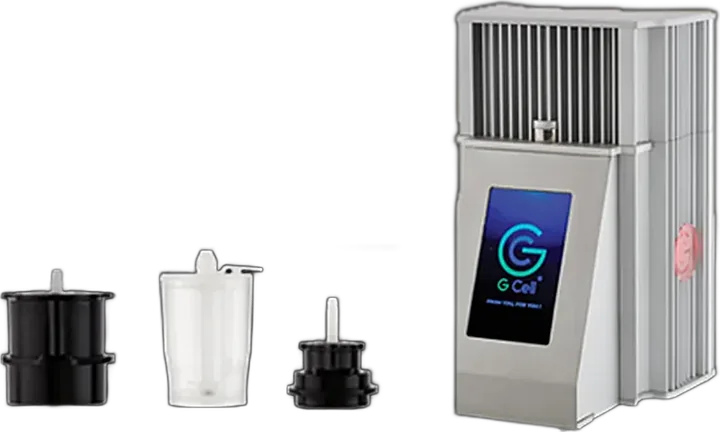
A device and disposable kits to prepare an autologous tissue suspension in your office, without chemicals or enzymes, in about 40 minutes and without an operating room.
- Preparationabout 40 minutes
- Sourcepatient's own tissue
- Processclosed, enzyme-free
- Kitshair and fat

Regenerative medicine
What you can offer in your practice
Hair loss
Autologous micrograft applied to the scalp.
An in-office procedure
No operating room and about 40 minutes of preparation, according to the manufacturer.
The patient's own tissue
No enzymes or chemicals, in a closed system.
Regenerative medicine
A high-value service line for your practice.
What it is and how it works
G Cell takes micrografts from the patient by punch, from the nape area, and processes them in the device with disposable kits, in a closed system, without chemicals or enzymes. The process includes photoactivation. The result is an autologous tissue suspension that is injected into the area to be treated.1
The line has two technologies: autologous micrograft, used mainly for hair loss, and stromal vascular fraction (SVF), obtained from fat.12 The manufacturer supplies the hair kits and the fat kits separately.

Technical data
- Manufacturer
- Global Biyomedikal, Istanbul, Turkey
- Technologies
- Autologous micrograft and stromal vascular fraction (SVF)
- Tissue source
- Autologous: punch micrografts from the nape area
- Process
- Closed system with disposable kits, without chemicals or enzymes, with photoactivation
- Preparation time
- About 40 minutes
- Presentation
- Device and disposable kits; hair and fat kits sold separately
- Setting
- Office; no operating room required
How it is performed in your office
Harvest the micrografts
By punch, from the patient's nape area.1
Process in the device
The micrografts are processed in the closed kit, enzyme-free, with photoactivation. Preparation takes about 40 minutes.1
Apply
Inject the suspension into the area to be treated, without the need for an operating room or anesthesia equipment.1
Follow up
The number of sessions is determined by the physician. Published studies with a similar technique used up to 3 sessions 45 days apart.4
Value for your practice
More than a product: a service line
Regenerative medicine attracts patients looking for alternatives with their own tissue. G Cell lets you offer it in your office with a compact device and disposable kits.
MedAesthetics Academy
Hair medicine
Basic and advanced course to master the technique, with our team's support after the course.
View the courseWhy professionals choose it
- In your officeNo operating room or anesthesia equipment, in a single visit for preparation and application.1
- From the patientAutologous tissue processed on the spot, without adding products of external origin.1
- Closed, standardized processDisposable kits, without chemicals or enzymes, with photoactivation included.1
- Two lines of workMicrograft for hair loss and fat-derived SVF for other indications.12
Compared with its category
Attributes published by each manufacturer or by studies, with the source of each data point. Last reviewed: October 29, 2026.
| Attribute | G Cell | Rigenera |
|---|---|---|
| Source | Autologous micrografts1 | Autologous micrografts3 |
| Processing | Closed kit, enzyme-free, with photoactivation1 | Mechanical fragmentation3 |
Comparison based on the information published by each manufacturer.
Evidence and support
- Gentile P. International Journal of Molecular Sciences, 2019.
Autologous micrografts by mechanical fragmentation and centrifugation (Gentile protocol) in androgenetic alopecia, 35 patients: 3 infiltrations every 45 days; density +33% and +27% versus baseline at 23 and 44 weeks after the last infiltration.4 - Ruiz RG et al. Journal of Cellular Physiology, 2020.
Dermal micrografts (Rigenera system) in androgenetic alopecia: improved density at 4, 6 and 12 months.3 - Manufacturer documentation
Your advisor provides Global Biyomedikal's technical documentation: protocol, kits and device specifications.
Indications and safety
Indications according to the manufacturer
Hair loss and hair transplantation, dermatology, aesthetic medicine and wounds, among others.1
Not recommended in
Patients undergoing cancer treatment, with autoimmune disease with extensive skin involvement, with coagulation disorders or thrombocytopenia, during pregnancy or breastfeeding, and in patients under 18.1
Possible effects
Mild bleeding, bruising and swelling in the treated area.1
We support you with G Cell
With your order you receive the manufacturer's technical data sheet and official instructions, plus an advisor who answers your technical and clinical questions before and after your purchase.
I'd rather be contacted
Questions about G Cell
What is G Cell?
A system by Global Biyomedikal (Turkey) that processes the patient's own micrografts in the office, in a closed, enzyme-free kit, for application in the area to be treated.
How long does preparation with G Cell take?
About 40 minutes, according to the manufacturer, and it does not require an operating room.
What is G Cell used for?
Mainly for hair loss with the micrograft technology; the SVF technology, obtained from fat, is used in other indications according to the manufacturer.
How do I buy G Cell in Costa Rica?
MedAesthetics sells G Cell to physicians, dentists and clinics. Message us on WhatsApp at +(506) 6047-8333 or leave us your details in the contact form, and an advisor will confirm availability and terms.
Sources
- Global Biyomedikal, GCell Autologous Micrograft Technologies (manufacturer's official website)
- Global Biyomedikal, GCell SVF Technologies (manufacturer's official website)
- Ruiz et al., J Cell Physiol 2020
- Gentile, Int J Mol Sci 2019