
Calcium Hydroxylapatite Biostimulator
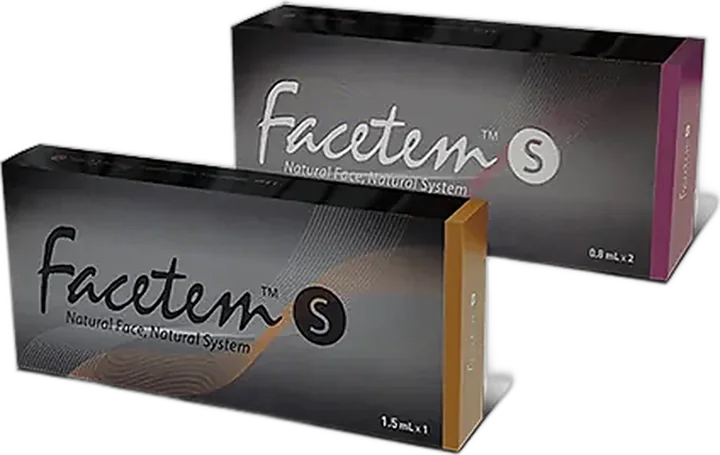
Facetem
Immediate volume and the patient's own collagen over time: calcium hydroxylapatite with more uniform microspheres in the laboratory.
Calcium hydroxylapatite microspheres with lattice pore technology, from a Korean manufacturer that has worked with apatite biomaterials since 1995.
- Hydroxylapatite30% in gel
- Mean particle size34.6 µm
- Undiluted G'1220 Pa
- Syringes1.5 ml and 0.8 ml

Biostimulate
What you can offer in your practice
Global rejuvenation
Collagen stimulation for skin quality, firmness and support.
Facial contour and support
Immediate volume in the jawline, cheekbones and chin.
Neck, décolletage and hands
Diluted protocols to improve skin quality.
Patients seeking a natural look
A progressive result, built with the patient's own collagen.
What it is and how it works
Facetem is a sterile, semi-solid dermal filler of calcium hydroxylapatite microspheres suspended in a carrier gel. It provides immediate volume and, over time, the particles stimulate the formation of the body's own collagen. It is biodegradable and, according to CGBIO, does not cause calcification or ossification in soft tissue.1
When the carboxymethylcellulose gel is resorbed, the microspheres activate fibroblasts, which form type I and III collagen.2 Its particles have a lattice pore structure (Lattice Pore) patented by CGBIO.3 In Korea it is marketed as DCLASSY.4

Technical data
- Manufacturer
- CGBIO Co., Ltd., South Korea
- Composition
- 30% calcium hydroxylapatite microspheres in 70% carboxymethylcellulose gel
- Particle
- Mean of 34.6 µm, concentrated between 25 and 45 µm
- Viscoelasticity
- G' 1220 Pa undiluted (1 Hz, 1%)
- Presentation
- Box of 1 syringe of 1.5 ml or 2 syringes of 0.8 ml
- Approvals
- TFDA license in Taiwan; marketed in Korea as DCLASSY
Indications and technique
Official indication
Tissue augmentation for facial contouring, wrinkles and folds, and moderate or deep skin depressions.1
Injection plane
Deep dermis and subcutaneous tissue, according to its approval in Taiwan.3
Dilution
In the laboratory it was tested neat and at eight dilutions with saline and with hyaluronic acid; extrusion was assessed with a 27G needle and viscoelasticity decreases with dilution. Follow the manufacturer's protocol.2
No hyaluronidase
Calcium hydroxylapatite is not dissolved by hyaluronidase: plan any correction from the initial assessment.
Value for your practice
More than a product: a service line
Biostimulators attract patients who don't want to look "filled" but better. Facetem lets you offer that progressive result with a material of the same class as the reference biostimulator, from a Korean manufacturer that has worked with apatite biomaterials since 1995.
MedAesthetics Academy
Collagen biostimulators
Basic and advanced course to master the technique, with our team's support after the course.
View the courseWhy professionals choose it
- Volume and collagenImmediate filling effect plus stimulation of type I and III collagen over time.12
- Uniform microspheresOnly 2.1% of particles smaller than 20 µm, versus 14.5% for the reference product, in a 2026 laboratory study.2
- Two volumes1.5 ml syringe or box of two 0.8 ml syringes, to match the volume to each patient's plan.1
- Biomaterials specialistCGBIO has researched apatite bone substitutes since 1995.5
Compared with its category
Attributes published by each manufacturer or by studies, with the source of each data point. Last reviewed: October 29, 2026.
| Attribute | Facetem | Radiesse | Sculptra | Ellansé |
|---|---|---|---|---|
| Material | Calcium hydroxylapatite1 | Calcium hydroxylapatite6 | Poly-L-lactic acid7 | Polycaprolactone8 |
| Particle | Mean 34.6 µm; 2.1% smaller than 20 µm2 | 25 to 45 µm; 14.5% smaller than 20 µm26 | See the product sheet | 25 to 50 µm8 |
| Carrier | Carboxymethylcellulose gel2 | Carboxymethylcellulose and glycerin gel6 | Powder for reconstitution7 | Carboxymethylcellulose gel8 |
The particle study is a laboratory study: it describes the material, not outcomes in patients.
Evidence and support
- Hong GW, Yi KH et al. Journal of Functional Biomaterials, 2026.
Laboratory study versus Radiesse: microsphere circularity 0.95 versus 0.88; 2.1% versus 14.5% of particles smaller than 20 µm; hydroxylapatite made up 99.09% of the mineral phase.2 - DEFINE trial (NCT07855224), CGBIO.
Clinical follow-up of Facetem S in nasolabial folds, 100 patients, multicenter. Planned start in January 2027.9
Indications and safety
Indications
Tissue augmentation for facial contouring, wrinkles, folds and skin depressions, in the deep dermis or subcutaneous plane.13
Precautions
Not dissolved by hyaluronidase. Assess previous permanent fillers and recent treatments in the area. Review the official instructions for use before injecting it.
We support you with Facetem
With your order you receive the manufacturer's technical data sheet and official instructions, plus an advisor who answers your technical and clinical questions before and after your purchase.
I'd rather be contacted
Questions about Facetem
What is Facetem?
It is a collagen biostimulator by CGBIO (South Korea): 30% calcium hydroxylapatite microspheres in a carboxymethylcellulose gel, with a particle size of 25 to 45 µm.
Is Facetem dissolved by hyaluronidase?
No. Calcium hydroxylapatite is not hyaluronic acid, so hyaluronidase does not dissolve it.
How is Facetem similar to Radiesse?
Both are calcium hydroxylapatite microspheres in a carboxymethylcellulose gel. In the laboratory, Facetem showed 2.1% of particles smaller than 20 µm versus 14.5% for Radiesse.
How do I buy Facetem in Costa Rica?
MedAesthetics sells Facetem to physicians, dentists and clinics. Message us on WhatsApp at +(506) 6047-8333 or leave us your details in the contact form, and an advisor will confirm availability and terms.
Sources
- CGBIO, official Facetem and Facetem S product page
- Hong et al., J Funct Biomater 2026
- Taiwan approval and Lattice Pore technology, Medigate 2026
- DCLASSY in Korea, Daily Pharm
- CGBIO and Facetem, Ajunews 2020
- Radiesse, FDA record P050052
- Sculptra, FDA approval
- Ellansé, de Melo et al., CCID 2017
- NCT07855224 trial registration