MedAesthetics Academy: Scientific library

What each technology is, how to read a technical comparison and what each term means. Last reviewed: November 3, 2026.

Injectables

Botulinum toxin type A

It temporarily blocks the release of acetylcholine at the junction between nerve and muscle. Formulations differ in molecule size, excipients and how they are stored. A key point when comparing: one brand's units are not equivalent to another's.

Facial hyaluronic acid fillers

They differ in hyaluronic acid concentration, cross-linking technology and the presence of lidocaine. The choice depends on the injection plane and the area: a firmer gel gives support in deep planes and a softer one adapts to delicate areas. They can be dissolved with hyaluronidase.

Body hyaluronic acid fillers

They use cross-linked hyaluronic acid in larger presentations, injected in the subcutaneous plane in areas of the body. Like facial fillers, they can be dissolved with hyaluronidase. There is a precedent in the category worth knowing: in 2012 the breast indication of a product of this type was withdrawn because it made breast images harder to interpret.

Collagen biostimulators

Instead of adding volume with a gel, they stimulate the tissue to produce collagen. The main materials are calcium hydroxylapatite, poly-L-lactic acid and polycaprolactone. Unlike hyaluronic acid, they are not dissolved by hyaluronidase, so they require more precision in plane and amount.

Injectable safety

Before injecting, it is important to know the vascular anatomy of each area, choose the right plane and have a plan for complications. Keep hyaluronidase available when working with hyaluronic acid. Record the product, lot and amount applied in each area in the patient's chart.

Devices

Wavelength and chromophore

Each laser emits a wavelength that is best absorbed by one tissue target, called a chromophore: melanin, hemoglobin or water. For example, 532 nm and 694 nm (ruby) are absorbed by melanin and used for pigment; 578 nm (yellow light) is absorbed by oxyhemoglobin and used for vascular lesions; 755 nm (alexandrite) is used for hair removal; 1064 nm (Nd:YAG) reaches deeper; and 10,600 nm (CO2) is absorbed by water.

Pulse duration: Q-switched, picosecond and long pulse

Besides wavelength, how long each shot lasts matters. Very short pulses, in nanoseconds (Q-switched) or picoseconds (about a thousand times shorter), fragment pigment without heating the surrounding tissue; they are used for spots and tattoos. Long pulses, in milliseconds, heat more gradually; they are used for hair removal, vascular lesions and dermal stimulation.

Q-switched Nd:YAG laser (1064 and 532 nm)

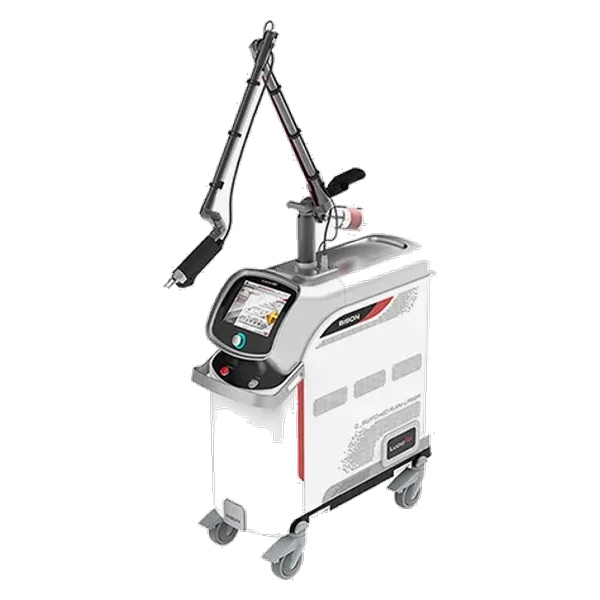
It emits at 1064 nm, which reaches the dermis, and with a frequency doubler at 532 nm, which stays in the epidermis. That is why it treats pigmented lesions in both layers and tattoos, and with longer pulses (quasi-long mode) it is used for toning and rejuvenation. LUCID Q-PTP adds PTP mode, which splits one pulse into two to reduce discomfort, according to the manufacturer.

Q-switched ruby laser (694 nm)

Its wavelength is very well absorbed by melanin and poorly by hemoglobin and water. It is used for pigmented lesions of the epidermis and dermis, such as freckles and café-au-lait spots, and for black, dark blue and green tattoos, colors that 532 nm treats less well.

Long-pulse alexandrite laser (755 nm)

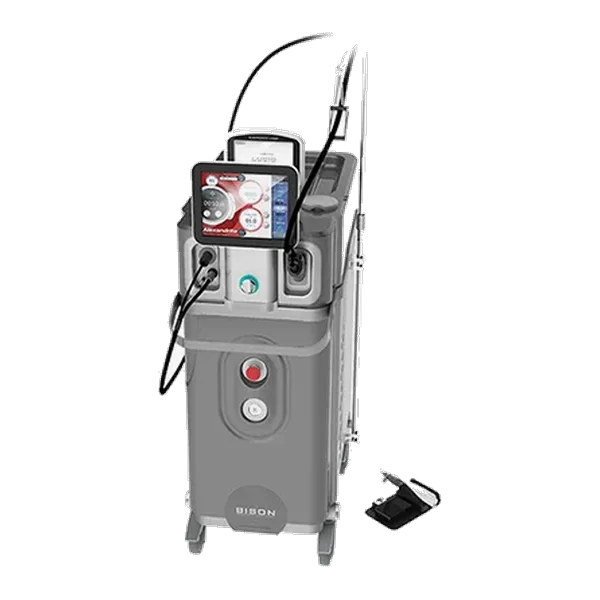
With a long pulse, alexandrite reaches the hair follicle and is highly absorbed by melanin, which is why it is one of the reference technologies for laser hair removal; it also treats pigmented lesions. Dual Accento combines it with a long-pulse 1064 nm Nd:YAG, which reaches deeper and is used for vascular lesions, rejuvenation and fine wrinkles.

Copper bromide laser (578 and 511 nm)

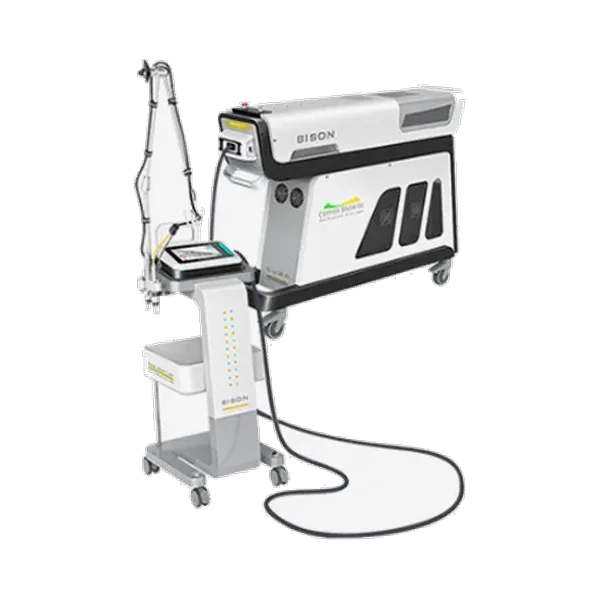
It is a copper vapor laser that emits two colors through the same fiber. The 578 nm yellow light is absorbed by oxyhemoglobin, so it is used for vascular lesions; the 511 nm green light is absorbed by melanin and is used for pigmented lesions. They can be used separately or combined, depending on the lesion.

Fractional CO2 laser (10,600 nm)

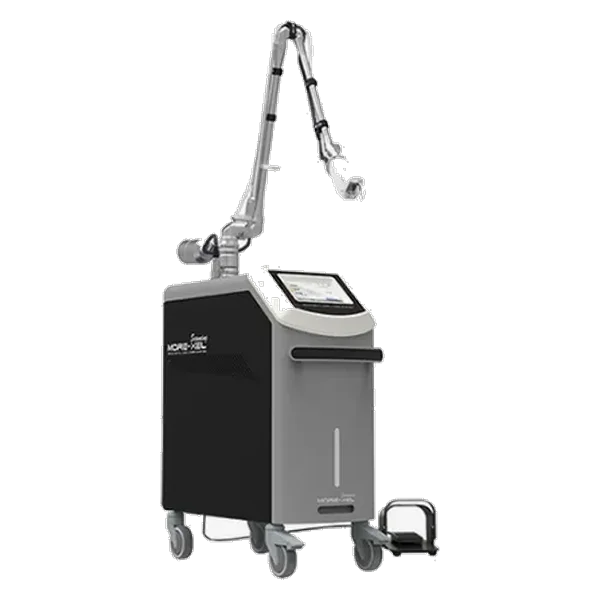
It emits at 10,600 nm, a wavelength absorbed by the water in tissue. In fractional mode it treats microscopic columns of skin and leaves healthy skin between them, which helps recovery and stimulates collagen formation. It is an ablative laser: it removes tissue. It is used for rejuvenation, texture and scars.

CO2 laser with radiofrequency

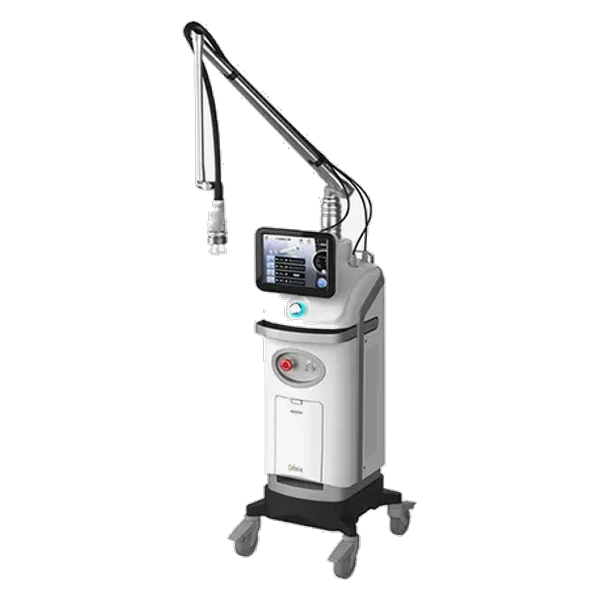
It combines fractional CO2 with radiofrequency in a single treatment: the laser acts on the surface and the radiofrequency heats deeper layers, with the aim of treating wrinkles and laxity. Cellene adds needle radiofrequency and a surgical mode for lesions up to 10 mm, according to the manufacturer.

Surgical, dental and gynecological CO2 laser

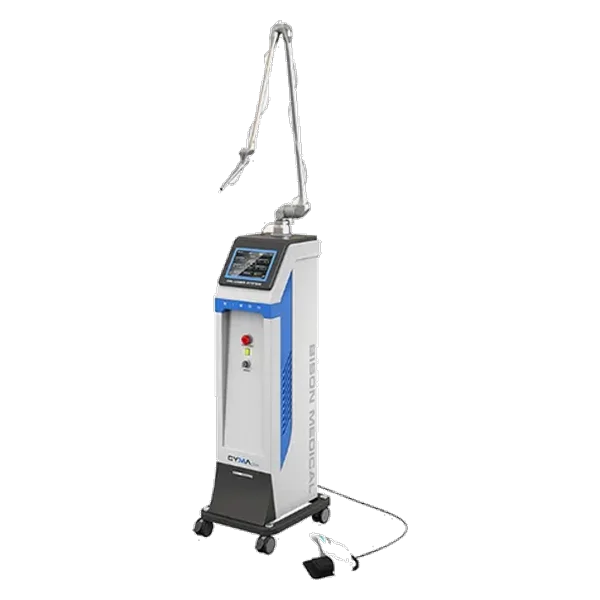
In continuous or pulsed mode (ultrapulse and superpulse), CO2 cuts and vaporizes tissue with little bleeding. That is why it is used in dermatologic and ENT surgery (CYMA Clinic), in dental procedures (CYMA Dental) and, with specific handpieces, in gynecology (Aphrodite). Each use requires training in the corresponding specialty.

HIFU: focused ultrasound

It concentrates ultrasound energy at a precise point, like a magnifying glass focusing light, without affecting the surrounding tissue. On the face the target is the SMAS layer, between the muscle and the subcutaneous fat, where heat stimulates collagen. It does not cut the skin, but it does not replace surgery.

Microneedle radiofrequency

Fine needles enter to a set depth and release radiofrequency inside the skin. This heats the deep tissue evenly and stimulates collagen formation, with less heat at the surface than external radiofrequency. It is used for rejuvenation, fine lines and minor scars.

Skin cooling

Cooling the skin before, during and after a laser or radiofrequency procedure improves patient comfort. ElaCool, by Bison Medical, cools the skin and uses electroporation to support product application, according to the manufacturer.

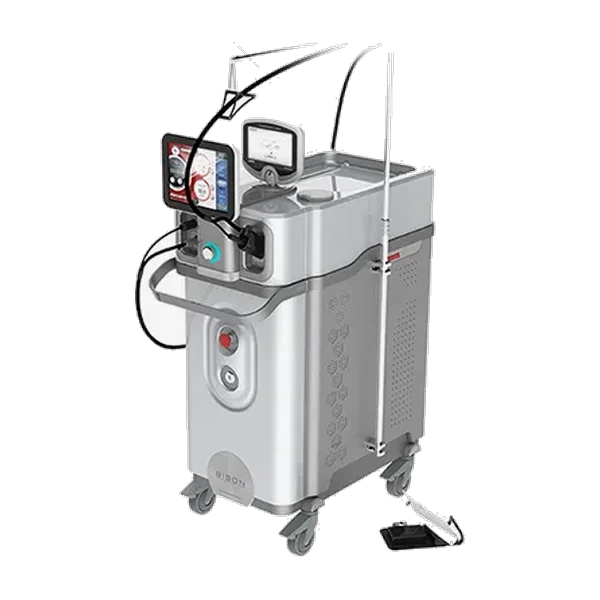
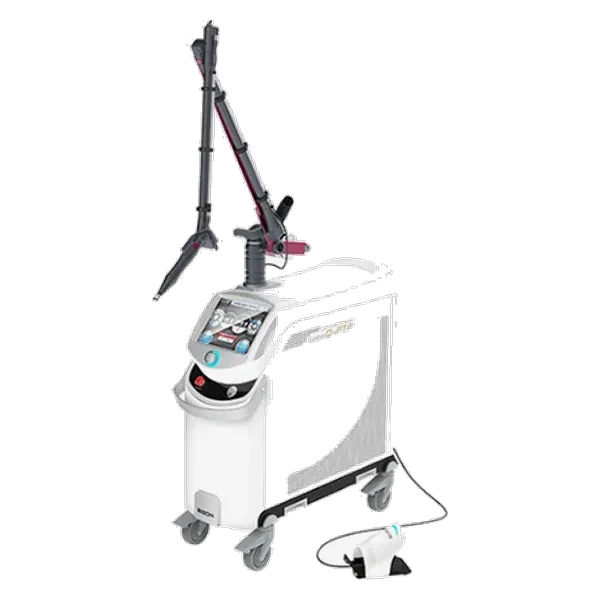
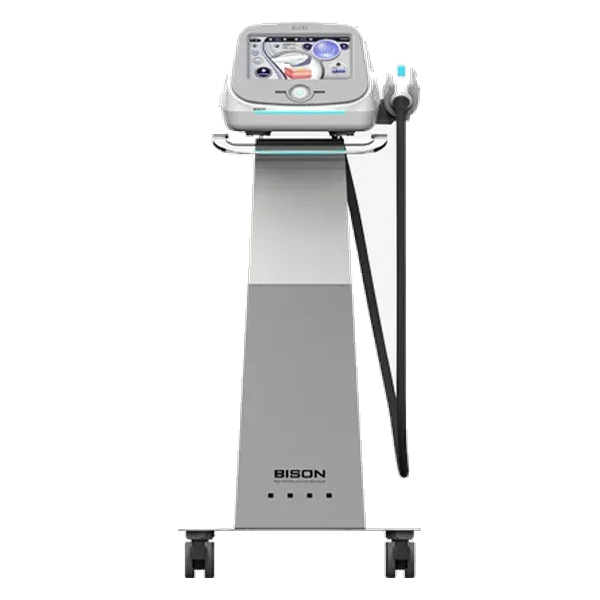
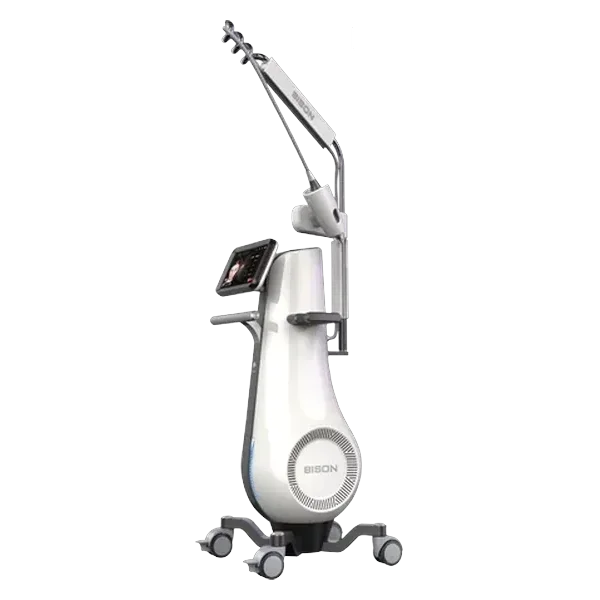
The 14 Bison Medical devices by technology

DeviceTechnologyWavelengthMain uses according to the manufacturer
LUCID Q-PTPNd:YAG laser1064 and 532 nmEpidermal (532 nm) and dermal (1064 nm) pigmented lesions · Tattoo removal · Toning · Soft peeling · Rejuvenation with Quasi-Long mode
RubyStarRuby laser694 nmEpidermal and dermal pigmented lesions · Multicolor tattoos (black, dark blue, green) · Freckles and café-au-lait spots
Copper BromideYellow and green laser511 nm (green) and 578 nm (yellow), combined or separateVascular lesions (578 nm) · Pigmented lesions (511 nm)
Dual AccentoAlexandrite laser755 nm and 1064 nmLaser hair removal · Pigmented lesions · Vascular lesions · Rejuvenation and fine wrinkles
Single AccentoAlexandrite laser755 nmLaser hair removal · Pigmented lesions
MORE-XEL ScanningCO2 laser10,600 nmSkin rejuvenation · Texture and scars · Laser surgery
FIRE-XELCO2 laser10,600 nmSkin rejuvenation and regeneration · Laser surgery
CelleneCO2 laser and radiofrequency—Skin rejuvenation · Wrinkles and laxity · Larger lesions (surgical mode)
CYMA ClinicSurgical CO2 laser10,600 nmDermatologic laser surgery · Otolaryngology procedures
CYMA DentalDental CO2 laser10,600 nmDental laser procedures
AphroditeGynecological CO2 laser10,600 nmGynecological CO2 laser procedures
ULCHEHIFU—Non-surgical lifting and tightening · Face and body
ElaDermMicroneedle RF—Collagen stimulation · Skin rejuvenation
ensembleMicroneedle RF—Minor scars · Fine lines and wrinkles · Skin elasticity

Hair and genetics

Scalp analysis

Analyzers with magnification and polarized light make it possible to measure density, thickness and scalp condition, and to compare progress at each follow-up. Some systems add artificial intelligence to classify scalp type.

Genetics and hair loss

Pharmacogenetic tests analyze variants associated with response to treatments. They guide the choice of actives; they do not replace clinical diagnosis or trichoscopy.

Genetic tests in other specialties

The same buccal swab can be used to study variants related to skin, nutrition, gynecology, aging and sports. The report combines the genetic analysis with a clinical questionnaire and is interpreted by the treating professional. Genetic information is sensitive data: in Costa Rica it is protected by Law 8968.

Regenerative medicine

Autologous regenerative medicine

It uses the patient's own tissue, processed in the office, instead of a product of external origin. In autologous micrografting, small skin samples are taken with a punch, processed in a closed system, and the suspension is injected into the treatment area; it is used mainly for hair loss. The stromal vascular fraction (SVF) is obtained from fat. The number of sessions is defined by the physician.

Personalized medicine

Custom compounding

It is a medicine prepared by a pharmacy for a specific patient, based on their doctor's prescription. It allows the concentration, the combination of actives and the form of application to be adjusted when no commercial product with that formula exists. In hair medicine it can be combined with a pharmacogenetic test to choose the actives.

How to read a comparison

  • A laboratory study describes the material; a clinical trial measures outcomes in patients.
  • An FDA 510(k) clearance is not an approval: it certifies equivalence with another device.
  • Data published by the manufacturer and data published in a scientific journal do not carry the same weight. On our product pages we always state which is which.

Glossary

510(k)
U.S. FDA clearance based on equivalence with a device that is already cleared. It is not the same as an approval.
Ablative
A laser treatment that removes part of the tissue, such as CO2. A non-ablative one heats the tissue without removing it.
Autologous
Coming from the patient's own body.
Autologous micrograft
Small skin samples from the patient that are processed in a closed system and injected into the treatment area.
Biostimulator
An injectable that stimulates the production of the body's own collagen, such as calcium hydroxylapatite, poly-L-lactic acid or polycaprolactone.
Botulinum toxin type A
A protein that temporarily blocks the signal from the nerve to the muscle.
Buccal swab
A sample taken by rubbing a swab inside the cheek, with no blood draw.
Calcium hydroxylapatite
A mineral in microsphere form that, within a gel, acts as a biostimulator.
CE marking
The European Union conformity mark for medical devices.
Chromophore
The tissue target that absorbs laser light: melanin, hemoglobin or water.
Complexing proteins
Proteins that accompany the toxin in some formulations.
Cross-linking
Chemical bonding of hyaluronic acid chains. The most widely used agent is called BDDE.
Custom compounding
A medicine prepared by a pharmacy for a specific patient, based on their doctor's prescription.
Fractional
A laser that treats microscopic columns of skin and leaves healthy skin between them to help recovery.
Genetic variant
A difference in a gene's sequence between people. Some are associated with the response to a treatment.
HIFU
High-intensity focused ultrasound. It concentrates energy at a deep point to generate heat and stimulate collagen.
Hyaluronic acid
A molecule present in the skin. In fillers it is cross-linked so that it remains longer in the tissue.
Hyaluronidase
An enzyme that dissolves hyaluronic acid. It allows a hyaluronic acid filler to be corrected; it does not act on biostimulators.
Injection plane
The tissue layer where the product is placed: dermal, subcutaneous or supraperiosteal, among others.
kDa (kilodalton)
A unit used to measure the size of a molecule.
Lidocaine
A local anesthetic that some fillers include to make the injection more comfortable.
MFDS
South Korea's food and drug regulator.
Microneedle radiofrequency
A technique in which fine needles enter to a set depth and release radiofrequency inside the skin.
Nd:YAG
A crystal laser that emits at 1064 nm and, with a frequency doubler, at 532 nm.
Non-inferiority
A study result showing that a product is not worse than another within a margin set in advance.
Pharmacogenetics
The study of how genes influence the response to a treatment.
Picoseconds
Pulses about a thousand times shorter than nanosecond pulses.
Q-switched
A laser with nanosecond pulses.
Sanitary registration
Authorization from the Ministry of Health of Costa Rica to market a product in the country.
SMAS
The tissue layer between the muscle and the subcutaneous fat of the face. It is the target of HIFU and of surgical facelifts.
Stromal vascular fraction (SVF)
A set of cells obtained from the patient's own fat.
Trichoscopy
Magnified examination of the hair and scalp.
Wavelength
The color of the light a laser emits, measured in nanometers (nm). It defines which chromophore absorbs it and how deep it reaches.